First of all, I don’t have
any good excuses for why I have not posted to my blog in so long, but I am
hoping to turn that around this semester. The first post in this new effort
serves to highlight a column written by my colleagues Beatriz Reyes-Foster and Ty Matejowsky, here at the University of Central Florida in Orlando. In this essay, they highlight the importance of undergraduate
education for Anthropology, not just at UCF, but everywhere. I think that
anthropologists should point out that the ideas and information we teach and
practice can make a difference to everyone, not just professors.
Wednesday, January 29, 2014
Tuesday, September 24, 2013
III EIAA in Quito
[image credit http://www.eiaa.com.ec/images/banners/home_eiaa.jpg]
The IIIEncuentro Internacionál de Arqueología Amazonica, or the Third International
Meetings for Amazonian Archaeology, were recently held at FLACSO, in Quito,
Ecuador. The lion’s share of the credit for organizing such a well-run and
teriffic conference goes to Stephen Rostain, who had the participants lodged
in a fine hotel, the Hotel Quito, shuttled by bus all over the city, including
to FLACSO, where the talks were held, and to museums all around the city, where
we attended all kinds of exhibit premieres and otherwise announced our presence
in the city. I hadn’t been in Ecuador in perhaps 13 years, and to my eyes Quito
has changed quite a bit. Of course, much of that is conditioned by staying in a
fancy tourist hotel, and spending dollars (US currency is valid in Ecuador). I
had the chance to catch up with several old friends, and make several new ones,
which really is the point of an academic conference. I am looking
forward to the next EIAA, which will be held in Iquitos, Perú.
Sunday, July 14, 2013
Home in Santa Ana
June 27, 2013
It's been raining every day since we got to Santa Ana, which
means the road is too bad to get to the site. However, there is plenty of lab
work to keep us busy. Washing, cataloguing, and photographing ceramics from
previous years. I enjoy getting to work with the ceramics in the lab (I may be
alone in the world on my love of ceramics though), especially before we go out
and dig, so I have an idea of what to expect. But today, finally! we saw the
sun. Hopefully it dried out the road enough that we can get into the field
tomorrow! --RK
Saturday, July 13, 2013
On the Bus
June 23, 2013
Today we made the trip from La Paz to Santa Ana. We took a
plane to Trinidad, I think, and then we were going to take a truck for the 6+
hour ride to Santa Ana. Just before we left though a guy in a bus drove up and
said he'd take us. So we took his offer and had probably the most comfortable
ride of anyone with the project to date. The bus had a horn that sounded
somewhat like an ambulance, and the driver used it to scare quite a few people, it was pretty hilarious.
We arrived in Santa Ana earlier than expected and were greeted by our awesome
host family.--RK
Monday, July 8, 2013
Plaza Murillo
June 21, 2013
Today is the winter solstice here in the Southern Hemisphere. We went to try and find an open museum but had no luck as the whole city was pretty much shut down. We came upon this square, filled with pigeons and people. It seems like every day we explore a new part of the city, and every day we find a new place that could be considered a 'center' of town. We found out that this square was in front of the president's house and other important governmental buildings. In the quiet city, this square was bustling with families eating ice cream and feeding pigeons. We also noted the 'rainbow flag' that we saw always flying next to the Bolivian flag. We assumed it was the indigenous flag, and some research confirmed this. It is very interesting to see a country that is so tied to its indigenous heritage (mostly because the president is indigenous and mandated the flags fly together, and that the city be shut down in honor of an Aymara holiday that falls on the solstice).--RK
Labels:
Alex Rivas,
fieldwork,
La Paz,
Rachael Kangas
Saturday, July 6, 2013
Parking Stickers
June 18, 2013
Saw this gem on the prado today. The UCF parking stickers
registered as normal in my head, but anything registering as normal requires a
second thought here. I can't believe, of all the places in the world, we found
a car in La Paz with recent UCF parking stickers (one was from 2012). While the
car was probably shipped here, it was fun to think about what the drive from
Central Florida to La Paz would be like. Based on a quick glance at a map, you
would have to go through 8 countries to get here: Mexico, Guatemala, Honduras,
Nicaragua, Costa Rica, Panama, Columbia, and Brazil. Although, according to
Mapquest, there is no actual route to do so. --RK
Labels:
2013,
Alex Rivas,
La Paz,
ProSIGAB,
Rachael Kangas
Wednesday, July 3, 2013
Into the Woods
We have now excavated shovel tests like this one in two lines, cutting across the forest island from north to south and from east to west. We dig a test every fifteen meters, which is about fifty feet. All of the tests from inside the ring ditch have fragments of ceramics in them, and very few of the tests from outside the ring ditch have ceramics in them, which tells us that people were making and using pottery inside the circle. Sometimes the shovel tests are more than a meter deep, with fragments still coming out in the screen. On the left is Mary Luz Choque, Alex Rivas in the middle, and Juan Pablo Avaroma is on the right. That blue tarpaulin help us put all the soil back in the hole, which is important because we don't want any cows to hurt themselves. --JW
Tuesday, July 2, 2013
National Museum of Art
[We have a pleasantly large backlog of blog posts to get through, so we will be moving back and forth chronologically for a few days--JW]
June 22, 2013--We went to the National Museum of Art today and I was blown
away. From the curation – organized to take the visitor through the history of
Bolivia's art from the 16th century, through to modern art, – to the security
guards making sure we didn't get too close to the art, to the vinyl lettering
on the walls, something which is a big ticket item in the US and I was very
surprised to see, this museum is top-notch. As a former intern at a fine arts
museum and part of a museum installation crew, I was very impressed with the
attention to detail and the scale and skill that went into creating this
museum. The pride Bolivia has in its heritage came through here, as with most
places in La Paz, and there was a notable emphasis on cultural revival.--RK
Monday, July 1, 2013
Rachael Kangas
Sunday, June 30, 2013
Shovel testing
After several days of rain, which made the dirt road impassable, we got to work this past Thursday at Isla San Francisco, a small island of forest just south of Santa Ana del Yacuma. Before we open a larger excavation, we are digging small "shovel tests", which are about 50 centimeters across, and help us determine whether or not people lived at this place in the past. In this picture, Mary Luz Choque, Alex Rivas and Mabel Ramos (left to right) are discussing the shovel test that can just be seen at the bottom center of the picture. This was one of the first tests on Thursday, and it is out in the open savanna just north of the forest. The line of shovel tests continues to the south, through the forest and out to the other side. -JW
Labels:
Alex Rivas,
fieldwork,
Mabel Ramos,
Mary Luz Choque
Friday, June 21, 2013
Ferris Wheel
June 17, 2013
Alex and I ventured into La Paz to try and find the stadium,
armed with the hotel map, we made our way out into the city. Unfortunately, we
could find then entrance to the parque urbano central, which (we think) the
stadium is on the other side of. Tomorrow is another day. On the walk back
toward la plaza de los estudiantes, where our hotel is, Alex spotted a Ferris
Wheel, so naturally we went to find it. There was a Peruvian food festival this
weekend which we missed, but the remnants of it were still present. The Ferris
Wheel and a 'viking ship' ride were still operating, and there were vendors
cleaning up and breaking down their stalls. We paid 16bs and rode in the pink,
Miley Cyrus Ferris Wheel car (are they called cars?). This city is full of
cultural events and takes pride in its diverse cultural heritage, we're glad we
could catch the end of the Peruvian food festival, although we enjoyed neither
Peruvian culture or food. Now we know yet another plaza where events are held
and will be careful to check it out if we remain in the city. --RK
Thursday, June 20, 2013
Blogging from Bolivia
The blog is going to take a new direction for the next six weeks or so, and post from our fieldwork in Bolivia. With me in the field this season is an excellent crew, and I hope that as a group we will be able to post at least a few times per week, with contributions in both Spanish and English. I'll ask each of our guest bloggers to introduce themselves as they post, but I can tell you that we have two students from the University of Central Florida, Rachael Kangas and Alex Rivas, and two students from the Universidad Mayor de San Andres, Mabel Ramos and Mary Luz Choque. The photo above is from the Hotel El Dorado in La Paz, looking up through the city towards the altiplano and El Alto.
Labels:
bolivia,
fieldwork,
group blog,
La Paz,
UCF
Wednesday, June 5, 2013
Lake returning to the Mamoré River
This photo was taken on the banks of the Mamoré, looking across at an oxbow lake as it empties back into the river. We had come to the edge of the big river as part of our survey and reconnaissance around Santa Ana in 2007. When a lake like this one breaks through the bank and pours back into the river, a huge number of fish comes along for the ride, and this fact is not lost on the birds that congregate over the breach, feasting on the fish. The lake is connected to the river for much of the year in the wet season (perhaps December to May), and then is isolated during the dry season (perhaps June to November). These kinds of seasonal changes are obviously important to plants, animals and people today, and they were likely important in the pre-Columbian past as well. This photo was taken on June 14, 2007, with a Canon PowerShot A640.
Labels:
2007,
fish,
Mamoré River,
oxbow lake,
survey
Wednesday, May 29, 2013
Development Economics on Trial
I was chatting with my friend Niklas Hultin yesterday when he recommended a book about a conflict between anthropology and economics. On his recommendation, I went to the library here at UCF and read the book right away. It's quite accessible, and is both engaging and well documented with supporting evidence. It's a sobering read for an archaeologist interested in agriculture, because Polly Hill (check out this interview) points out how difficult it is to characterize and describe agriculture in the tropics. Some of her strongest points include how ambiguous official statistics can be, how much inequality there can be (and usually is) among farmers, and how farmers do all kinds of things in addition to cultivating, including loaning and borrowing money, trading, and crafts like blacksmithing. Hill's examples are drawn primarily from sub-Saharan Africa and South Asia. It seems even more bleak when I consider that these are economists, agronomists and anthropologists who have the chance to talk to farmers, not archaeologists trying to interpret material evidence. On the other hand, in pre-Columbian eastern Bolivia at least we have access to some direct evidence of what fields look like, how big they are, and where they are located. That's not always the case in the tropics, as Hill convincingly emphasizes.
Labels:
Africa,
book,
development economics,
Polly Hill,
South Asia
Friday, May 24, 2013
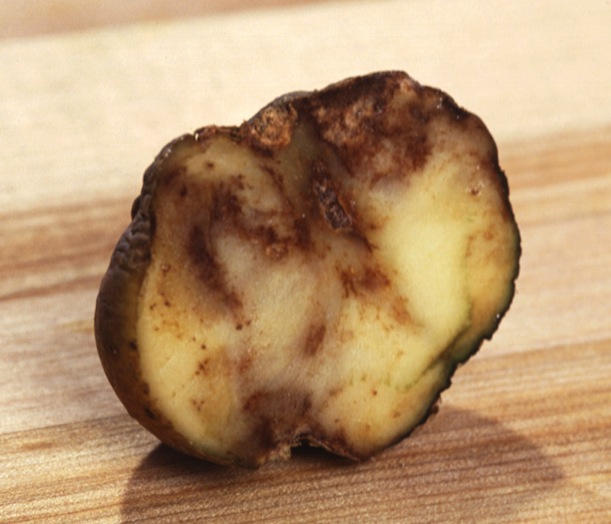
Potato Blight
Photo from the USDA
The Smithsonian's blog highlights research sequencing the organism that caused potato blight in Ireland in the mid 1800s. The blog post (and the comments) show how research like this is connected to modern politics, even when the events are 150 years old. It's also interesting to think that this research made use of botanical collections that were made at the time. Apparently, it could lead to more research using dried plant remains. That would open up the collections of museums and botanical gardens around the world. As far as the relationship between potato blight and the potato famine, I think that Glenn Stone's blog and Eric B. Ross' book about Malthus are worth reading.
Monday, May 20, 2013
Touring Ancient Times
(from Silverman 2002:889)
Back in 2002, Helaine Silverman published this article about tourism and archaeology in American Anthropologist, arguing that the local context is where we should concentrate our attention, rather than exclusively on the nation. Her examples were from Peru, with the Inca capital of Cuzco compared to the Nazca lines. I have been thinking that her comparison is not so different from the difference between the monumental city of Tiwanaku, and the earthworks of the Bolivian Amazon. The Nazca lines and Amazonian earthworks are not so easy to appreciate from ground level, especially for the tourist. I am not by any means an expert on tourism, but I am trying to become more of one, because eastern Bolivia is becoming more accessible all the time, and perhaps with the new UNESCO designation for San Ignacio, more tourists will be interested in visiting.
Silverman, Helaine. 2002. Touring Ancient Times: The Present and Presented Past in Contemporary Peru. American Anthropologist 104(3):881-902.
Subscribe to:
Posts (Atom)